Your crew needs to get off the ground safely, work efficiently, and move to the next job without wasting half the day on setup. The equipment you choose determines how much of that really happens. Spider lifts, bucket trucks, and towable lifts each solve the access problem differently, and the right choice depends on the kind of work you do, the sites you work on, and how your operation is set up.
Three Lift Types, Three Distinct Jobs
Not every aerial lift performs the same job, and choosing the wrong one costs you time, money, and sometimes the job itself. Tree service crews typically work with three categories of aerial equipment: bucket trucks, towable lifts, and specialized arborist spider lifts.
Each one fills a different role depending on access, terrain, and the kind of work your crew handles most. Understanding where each type excels and where it falls short will help you match the right machine to the right job instead of forcing one platform to do everything.
Bucket Trucks: The Familiar Workhorse
Bucket trucks have been the default for decades. They offer solid reach, a stable platform, and can double as transport for your crew and gear. For wide-open commercial properties with paved access, bucket trucks still make sense.
But they come with real limitations. Bucket trucks need firm, level ground and a clear path wide enough for a full-size truck. It rules out a lot of residential work, backyard access, and anything on a slope. Setup takes time, and turf damage on residential lawns is a continual headache. Add in fuel costs, CDL requirements, and maintenance on a heavy truck chassis, and the total cost of ownership adds up fast.
Towable Lifts: Lightweight and Portable
Towable lifts are the entry point for many tree service companies. They hitch to a pickup or work truck are relatively affordable, and elevate your crew on straightforward jobs.
The trade-off is capability. Most towable lifts have limited reach, less stability on uneven ground, and minimal articulation. They work fine on flat residential driveways and low-canopy trimming, but when the terrain gets rough or height requirements increase, they hit their ceiling quickly.
How to Compare Tree-Cutting Lifts
Spec sheets are useful, but the real comparison happens on the ground. Here is what matters most when your crew arrives at a job:
|
Factor |
Bucket Truck |
Towable Lift |
Spider Lift |
|
Reach / Height |
High (50–80 ft typical) |
Low–Moderate (30–50 ft) |
Moderate-High (40–100+ ft) |
|
Tight Access |
Poor (full truck width) |
Moderate (needs tow path) |
Excellent (fits through gates) |
|
Uneven Terrain |
Limited (needs level ground) |
Limited |
Strong (self-leveling) |
|
Turf Impact |
High |
Moderate |
Low (tracked chassis) |
|
Setup Time |
Moderate–Long |
Short–Moderate |
Short |
|
Transport |
Self-contained (CDL may apply) |
Requires tow vehicle |
Trailer or self-load |
|
Stability at Height |
Good (on level ground) |
Adequate |
Excellent (outriggers + tracks) |
Residential vs. Commercial: Matching the Lift to the Work
The type of property you work on most should drive your equipment decision more than any single spec.
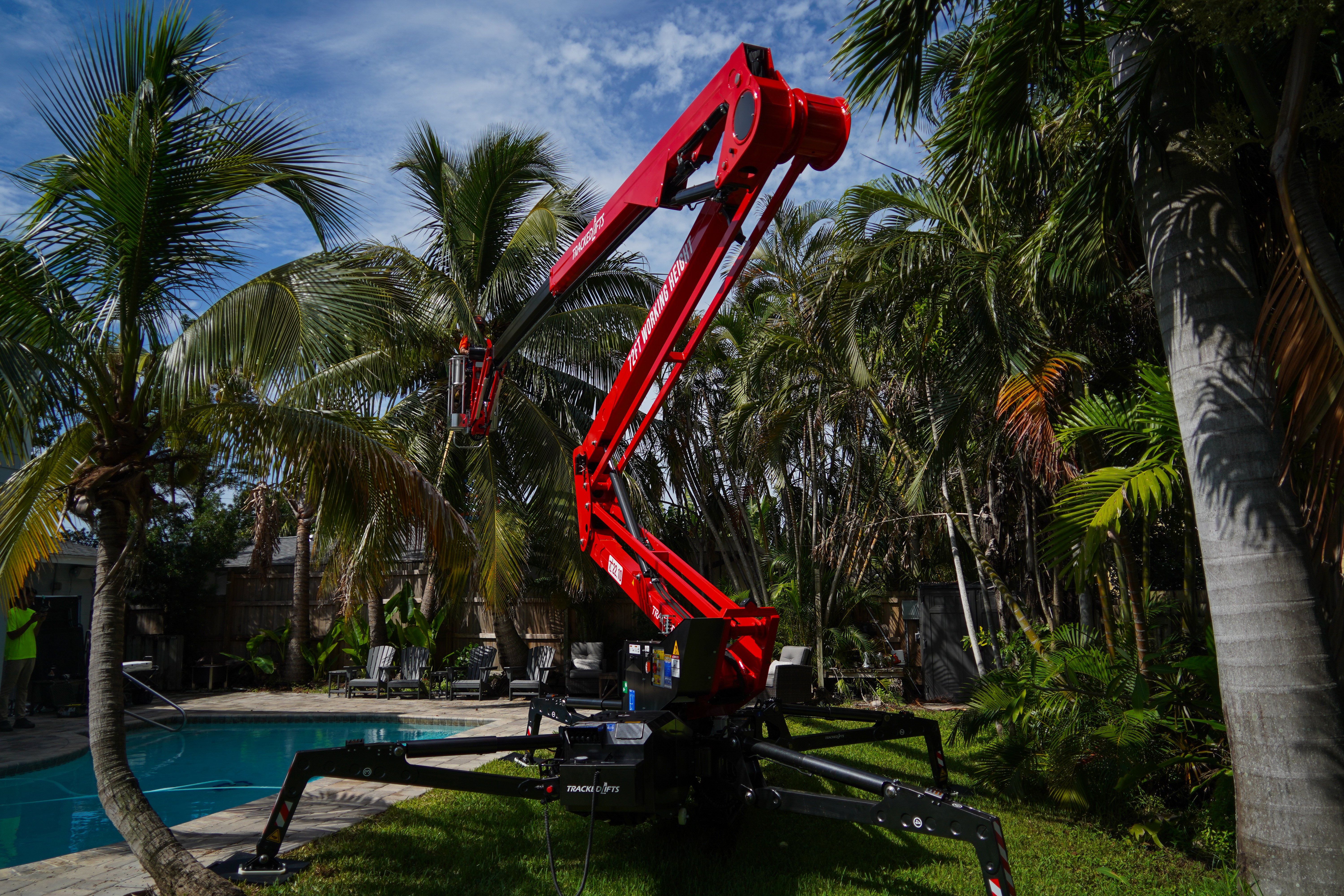
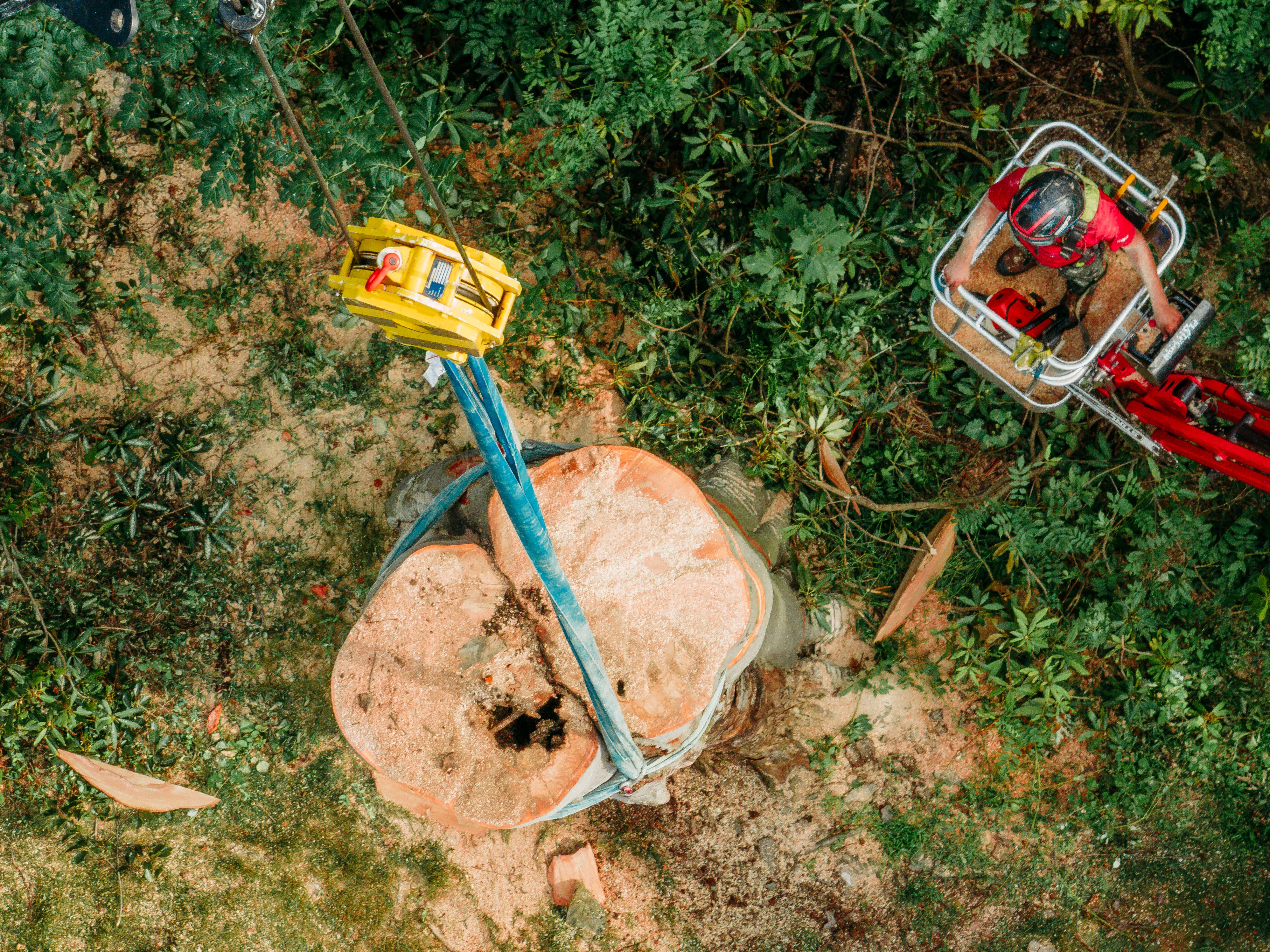
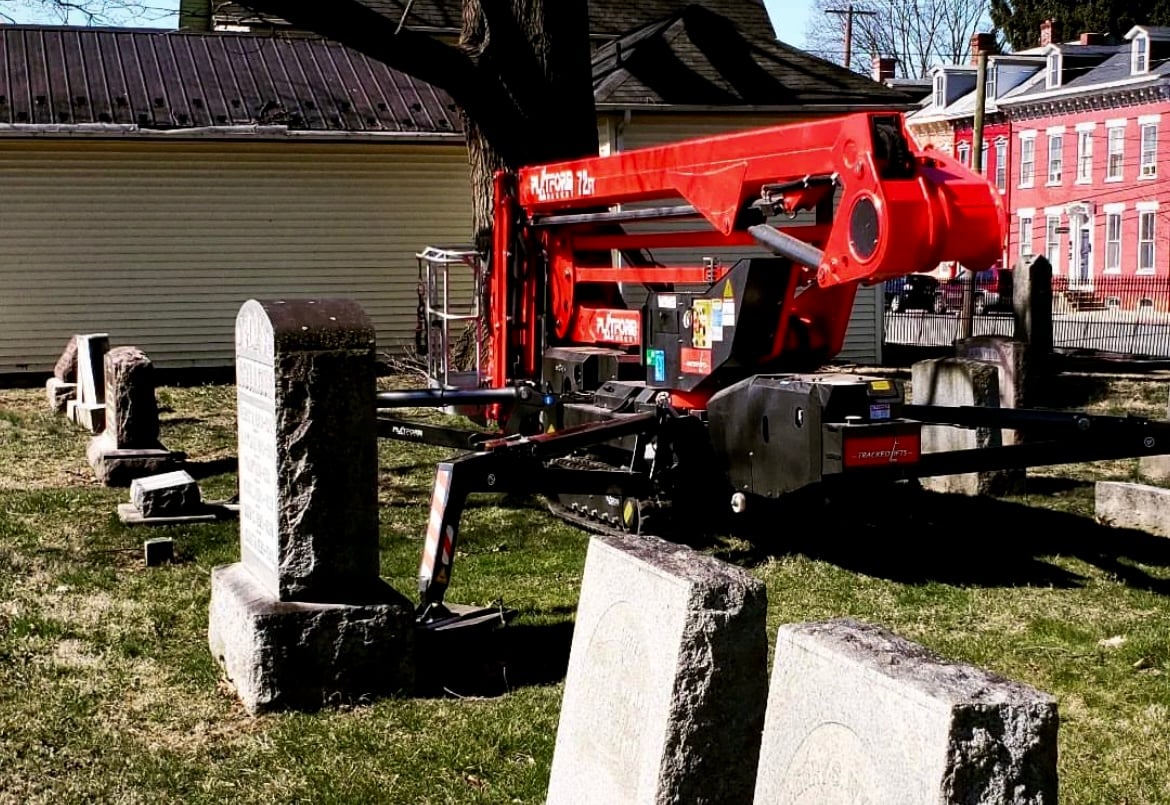
Residential tree work usually means tight backyards, narrow side gates, soft lawns, and homeowners who notice every tire track left behind. Spider lifts were designed to take on these exact conditions. Their compact footprint gets through 36-inch gates, their tracks minimize lawn damage, and their articulating booms reach over structures and around obstacles.
Commercial work on open properties with hardscape access may still favor a bucket truck for raw speed and simplicity. If your crew splits time between residential and commercial jobs, a spider lift covers both, while a bucket truck only covers one; in broader terms, spider lifts differ from traditional boom lifts by offering that same versatility in tighter, more complex environments.
Towable lifts are best as a supplemental tool for low-height, easy-access work where the job does not justify mobilizing larger equipment. Facility managers and maintenance teams may instead prioritize choosing the right lift for their facility based on indoor access, floor loading, and ceiling height.
Ownership, Rental, and Total Cost Considerations
Purchase price is but one line in the real cost equation. Maintenance, fuel, insurance, transport, and downtime all count.
Bucket trucks carry the highest total cost of ownership: commercial vehicle insurance, CDL-licensed operators, diesel fuel, and heavy-duty maintenance. Towable lifts cost less upfront but may limit the jobs you can take, which caps your revenue potential.
Spider lifts sit in between on purchase price but often deliver the best return because they let your crew access jobs that other lift types cannot, especially when you consider spider lift lifetime value and durability. Every job turned down because your equipment cannot reach the site is lost revenue.
If you are not ready to buy, rental programs let you test a lift type on real jobs before committing. Just make sure you are comparing apples to apples: factor in rental delivery fees, insurance, and the productivity difference between lift types on your actual job mix.
Crew Size and Skill Level
Bucket trucks typically require a CDL-licensed driver and at least a two-person crew. Towable lifts need a tow vehicle and driver, plus someone operating the lift. Spider lifts can be operated by a single trained operator, though most crews run with a spotter for safety, and options such as electric and hybrid spider lifts can further simplify operation in noise- or emission-sensitive areas.
Training matters regardless of lift type. But spider lifts are often easier for newer operators to get comfortable with because the controls are intuitive and the tracked chassis handles terrain adjustments that would involve manual repositioning with other equipment.
FAQs
Which lift type is best for residential tree work?
Spider lifts are the strongest option for residential jobs because they fit through narrow access points, minimize lawn damage, and tackle uneven terrain without repositioning.
Can a spider lift replace a bucket truck?
For most tree service operations, yes. Spider lifts match or exceed bucket truck reach while adding access capabilities that bucket trucks cannot offer. The exception is high-volume commercial work on flat, paved sites where a bucket truck's speed and simplicity may edge out.
Do I need a CDL to operate a spider lift?
No. Spider lifts are typically transported on trailers and often do not require a CDL to tow . Some larger bucket trucks do require a CDL depending on GVWR.
What is the cost difference between these lift types?
Towable lifts have the lowest purchase price. Bucket trucks have the highest total cost of ownership. Spider lifts typically fall between the two on upfront cost but deliver the strongest ROI for operations that contend with diverse job sites.
Which Lift Suits Your Crew?
The right lift is the one that lets your crew work safely, move quickly, and take on the jobs that grow your business. If your operation handles mostly residential work, storm jobs, or anything with limited access, a purpose-built spider lift is the modern standard. If you are running wide-open commercial sites all day, a bucket truck still earns its place. Towable lifts work as a supplemental tool for lighter jobs.
We have seen crews transform their operations by switching to equipment that fits their actual work. If you want to talk through what makes sense for your job mix, our team is happy to help.
Ready to find the right lift for your crew? Get a quote or schedule a conversation with our team. We will match you to the equipment that suits your operation.