Spider and boom lifts are two types of aerial lifts that grant you access to hard-to-reach areas. While similar in structure and having many of the same uses, traditional boom lifts use wheels, and spider lifts have tracks and outriggers.
You can rely on these powerful machines for various tasks and applications, whether you're in tree care, construction, facility management, or another industry. Continue reading to discover the benefits and key differences of spider lifts vs. boom lifts and how they work.
What Is a Boom Lift?
Boom lifts are vehicle-mounted devices with extendable platforms. They have a hydraulically controlled arm attached to a grounding base, with a platform or bucket at the end. This allows for both vertical and horizontal movement.
These devices are often used to work closely on buildings or around obstacles, as they allow you to reach heights safely while moving horizontally and vertically.
Benefits of boom lifts include:
- Precision when navigating around work zones
- Increased stability and mobility when working at heights
- Improved productivity and safety
- Horizontal reach for assessing areas that extend outward from the base, especially in large, open spaces
Boom lifts are used primarily in construction, maintenance and industrial settings. They can help with tasks like pruning or cutting trees, erecting scaffolding, installing electrical equipment, painting, and washing windows.
Two basic types of boom lifts exist — articulating boom lifts have bendable arms to move the bucket around barriers, while telescopic boom lifts have straight arms and higher weight capacities that are typically more challenging to maneuver. To ensure safe operation and routine inspections, it's important to check spider lifts before use.
What Is a Spider Lift?
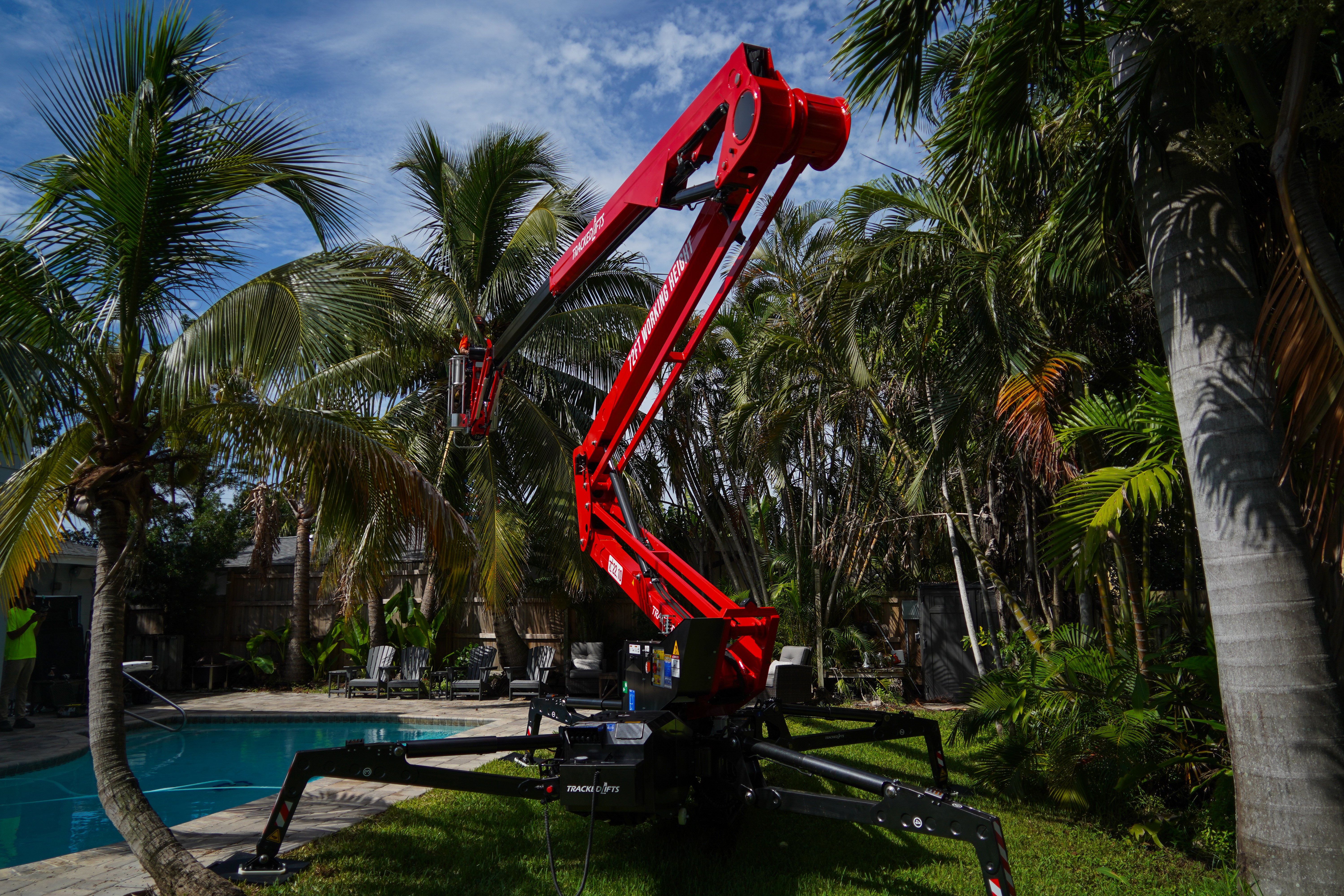
Spider lifts are aerial lifts with four legs and a bucket on the end of the boom. They are used to elevate workers to high areas, and their outriggers hold them firmly to the ground, providing extra stability.
Most spider lifts feature four hydraulic outriggers, which are independently adjustable to ensure stability on uneven terrain and in narrow or rugged environments. In contrast to traditional boom lifts, which have wheels, spider lifts have tracks that make them easy to navigate on uneven or rough terrain.
Benefits of spider lifts include:
- Safe, stable access to hard-to-reach places
- Access to heights on almost any terrain
- No need for ladders or climbing
- Precision and easy maneuverability
- Compact design for maneuverability in tight or restricted spaces
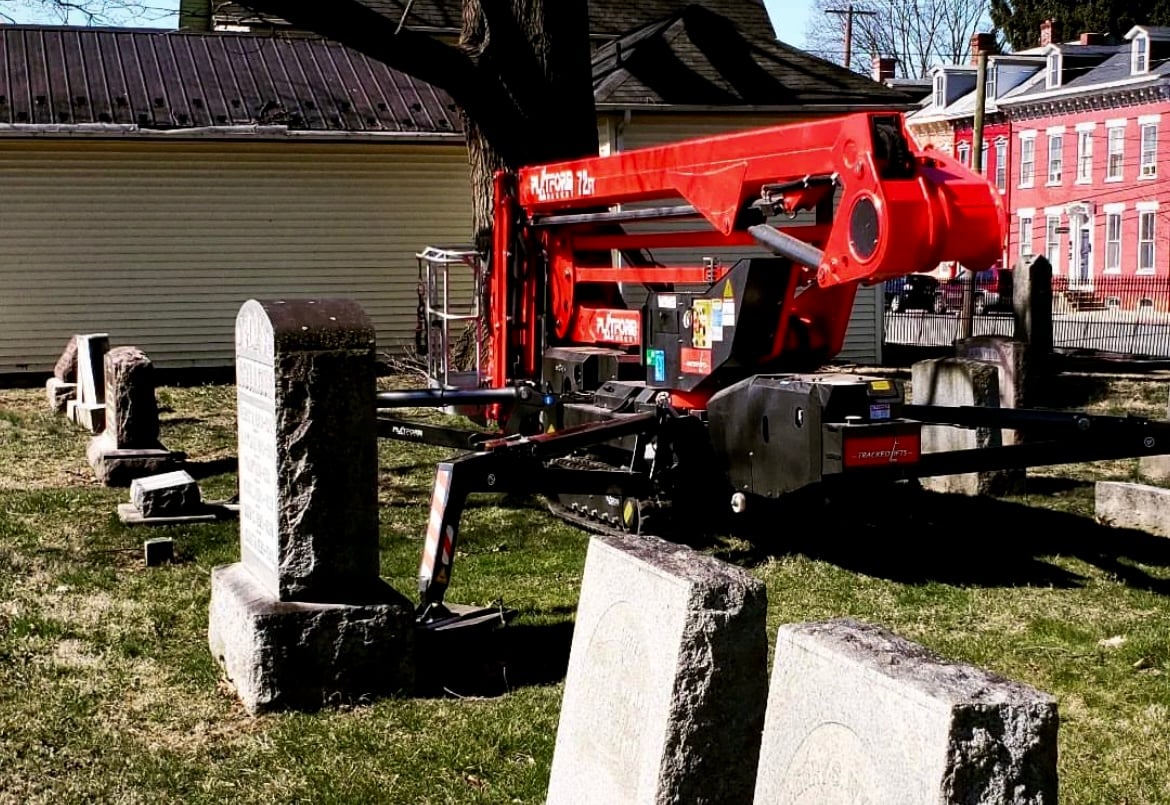
Due to their lightweight design and compact size, spider lifts are ideal for working in small spaces and navigating uneven landscapes, making them ideal for tree pruning or removal. Their lightweight nature also ensures you can navigate delicate surfaces like indoor flooring. Tracked Lifts offers multi-terrain lifts, including OMME and Platform Basket tracked lifts, that can help you get the job done safely and efficiently.
Key Differences Between Spider Lifts and Boom Lifts
Spider lifts and boom lifts differ in terms of maneuverability, terrain adaptability and ease of use. Choosing the right equipment for your specific jobsite needs and conditions is crucial to ensure safety, efficiency, and optimal performance.
Maneuverability
The compact size and lightweight design of spider lifts make them easier to maneuver compared to traditional boom lifts. Spider lifts can also move in multiple ways and directions, allowing them to reach tight spaces and bypass obstacles with ease. The base of the arm is mounted to a turntable, allowing it to rotate in a full circle.
Stick or telescopic boom lifts have a straight arm that cannot bend — the mast can only extend in a straight line and swing into position. While they have exceptional reach, they are often more challenging to move and navigate around obstacles, especially in worksites with limited space.
Terrain Adaptability
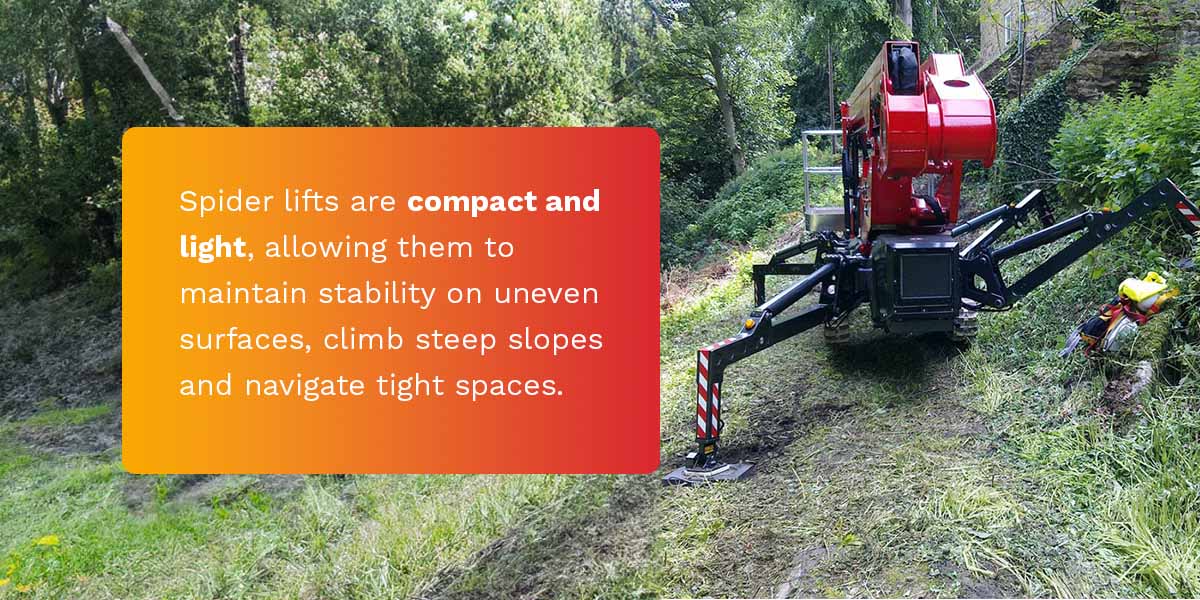
Spider lifts are compact and light, allowing them to maintain stability on uneven surfaces, climb steep slopes and navigate tight spaces. With these powerful machines, you can work on various terrains and jobsites, maneuvering into stable and comfortable positions to perform aerial tasks. Many spider lift models have auto-leveling capabilities, helping operators set up the machine easily, even on irregular terrain.
In contrast, traditional boom lifts are large, heavy-duty and bulky, making them best suited for over-obstacles tasks in open spaces.
Ease of Use
Spider lifts have “legs” called outriggers that lock into place, allowing better stability on various types of terrain. You can easily and safely position them on multi-leveled platforms and gradients or steps using the articulating booms and jibs. They offer some of the industry's best safety features and easy-to-use control panels that make operation more straightforward and safe.
Traditional boom lifts are also easy to use and set up after undergoing proper training. They offer a convenient way to reach higher places, can be safer than ladders, and are more versatile than scaffolding.
According to the Occupational Safety and Health Administration, only authorized and trained personnel are allowed to operate aerial lifts, including spider and boom lifts. You'll need certification using theory, practical and fall protection training, which can help you operate the lift safely and effectively.
The Versatility of Spider Lifts vs. Boom Lifts
Spider lifts and boom lifts differ in their jobsite accessibility, efficiency and industries. Boom lifts are particularly well-suited for large outdoor projects due to their impressive reach and capacity, making them ideal for covering wide, open spaces at height.
Both boom lifts and spider lifts offer versatility and are designed to meet the needs of various work environments, helping users select the right equipment for specific height or space constraints.
Jobsite Accessibility and Efficiency
Spider lifts are among the most versatile aerial lift options. They perform in various environments and terrains, and their lightweight nature allows them to traverse delicate surfaces and indoor flooring. In comparison, boom lifts are typically suited for outdoor use, as they are usually bigger and have a wider range of motion.
At Tracked Lifts, many of our spider lifts fit in doorframes, allowing you to complete indoor maintenance and other construction needs, such as changing a lightbulb in a gymnasium. Their rubber tracks help them maneuver confined spaces with excellent traction, making them ideal in warehouses, factories and tree care services. They can safely pass narrow doorways while working at heights up to 100 feet.
Industry-Specific Applications
Traditional boom lifts are less versatile than spider lifts but make an excellent option for heavy-duty construction projects that require ample space, personnel and materials.
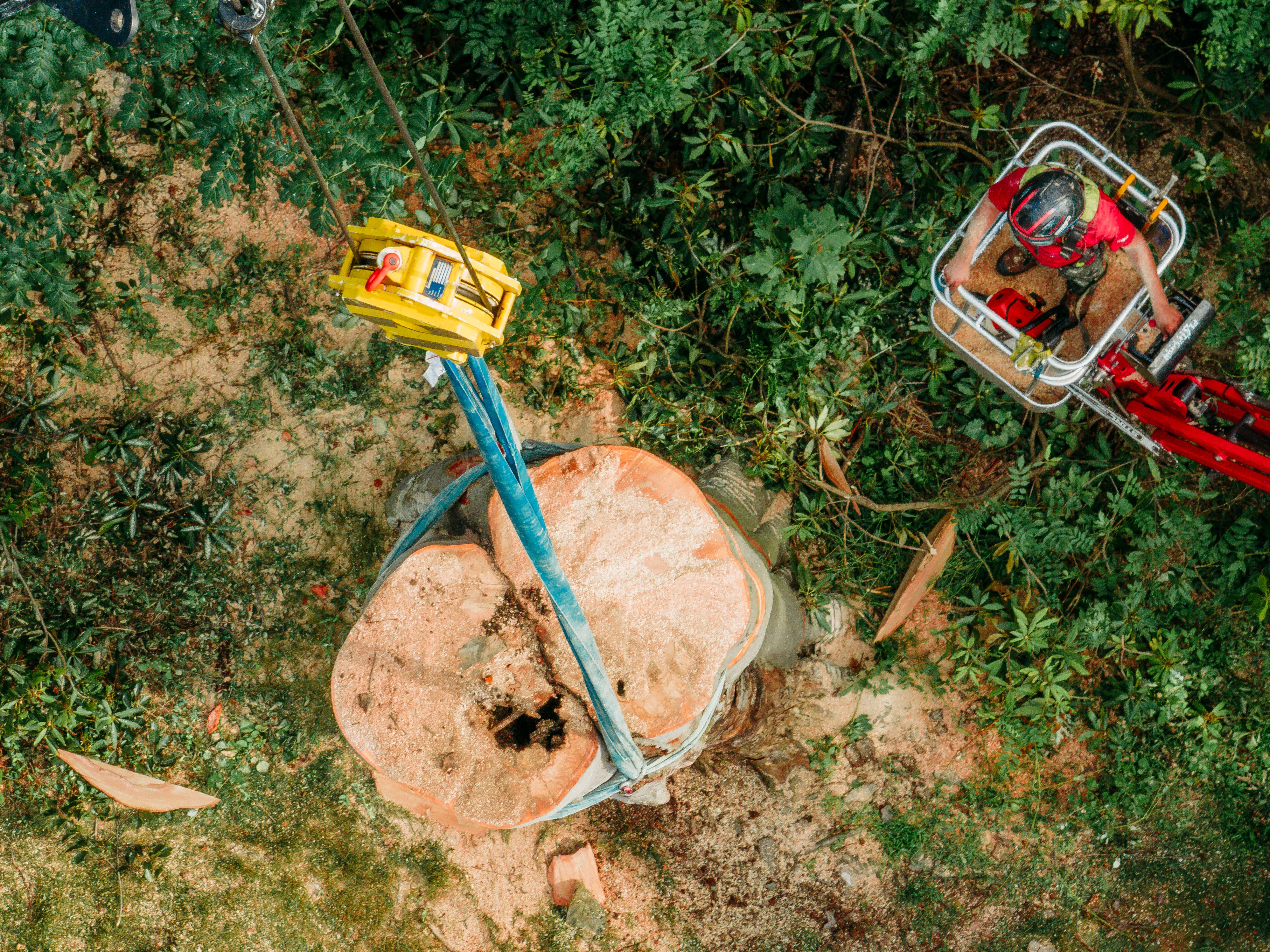
Spider lifts can be used for everything from simple building maintenance and tree trimming to industrial applications in rugged environments. They're excellent for tree removal, trimming, pruning and reaching high branches without damaging the tree or surrounding area.
At Tracked Lifts, our spider lifts are purpose-built for arborists. Their hydraulics are protected within the boom, allowing them to go through branches without breaking. We also supply compact lifts that are optimal for various outdoor building maintenance tasks, from repairing and remodeling structures to cleaning windows.
FAQs
When should I choose a boom lift instead of a spider lift?
Boom lifts are a good option for large, open construction sites where long horizontal reach and higher material capacity are needed. They’re commonly used for heavy-duty construction, steel erection, and large-scale maintenance projects.
Do spider lifts work on uneven or sloped terrain?
Yes. Spider lifts are specifically designed for uneven ground. Their tracked bases, outriggers, and auto-leveling systems allow them to operate safely on slopes, stairs, gravel, grass, and other challenging surfaces.
Are spider lifts harder to set up than boom lifts?
Spider lifts require outrigger deployment, but modern models are designed for quick and intuitive setup. Many operators find spider lifts easy to position precisely, even in tight or irregular spaces.
Can spider lifts reach the same heights as boom lifts?
Spider lifts can reach impressive heights—often up to 100 feet—while maintaining a smaller footprint. However, some large boom lifts may offer greater horizontal outreach or higher load capacities for specific applications.
Why are spider lifts considered more versatile than boom lifts?
Spider lifts can be used across a wider range of environments, including uneven outdoor terrain and indoor spaces. Their compact size, low ground pressure, and precise maneuverability make them suitable for tree care, facility maintenance, construction, and industrial work.

Explore Quality Spider Lifts at Tracked Lifts
While boom lifts are excellent for heavy-duty tasks, spider lifts are more versatile, compact, and well-suited for various industries and applications.
Tracked Lifts provides a wide range of tracked multi-terrain lifts, including high-quality spider lifts. We are the exclusive continental U.S. importer and supplier of Platform Basket and OMMELIFT. Our technicians offer expert advice and rental options to help you get the job done safely and correctly.
To get started, reach out to one of our experts today.